Knowledge Mobilisation

In 2017 I took a leap of faith and went to a conference in Bristol run by a woman I’d met on an RCT. (Don’t know what an RCT is? More here)

I enjoyed that conference so much I joined the committee to organise the following year’s conference, and I’m still there.

As you know, I don’t work for a University research team, or NHS, or the social services, but I still really enjoy the Knowledge Mobilisation Forum conference. It challenges me to think differently about how we can get knowledge learned and shared around organisations.

I’ve seen successful knowledge sharing through board games and poetry, lego and junk-modelling and there have been *a lot* of opportunities for conversation and sharing of experiences (I’ve also heard a lot of jargon and competitive framework-design but nothing is perfect). I’ve met people who work with charities and human rights organisations, as well as those researching in universities and working at the frontline in NHS, and people from all over the world.

It’s certainly not the kind of knowledge sharing and learning you get in the mainstream legal sector or at a conference aimed at law firms’ or big business’s KMers.

I mightn’t suggest poetry as a means for knowledge sharing amongst lawyers, but being challenged in this way certainly makes me think a bit harder about my own practice.

So if you think you would benefit from a bit of shaking up, and think a bit of challenge and stimulation for your Knowledge and Learning practice would be beneficial, consider coming along. It’s also very reasonably priced and tries to be Green/sustainable.

The next conference will take place in Birmingham on 17th-18th March, 2020, so save the date.

Bit unsure? Have a look at the twitter moment from this year’s conference in Newcastle. It’s going to be hard to top – highlights were a beautiful and thought provoking key note from Ishbel Smith and an inspiring location at Seven Stories, the national centre for children’s books – but we have lots of great ideas!
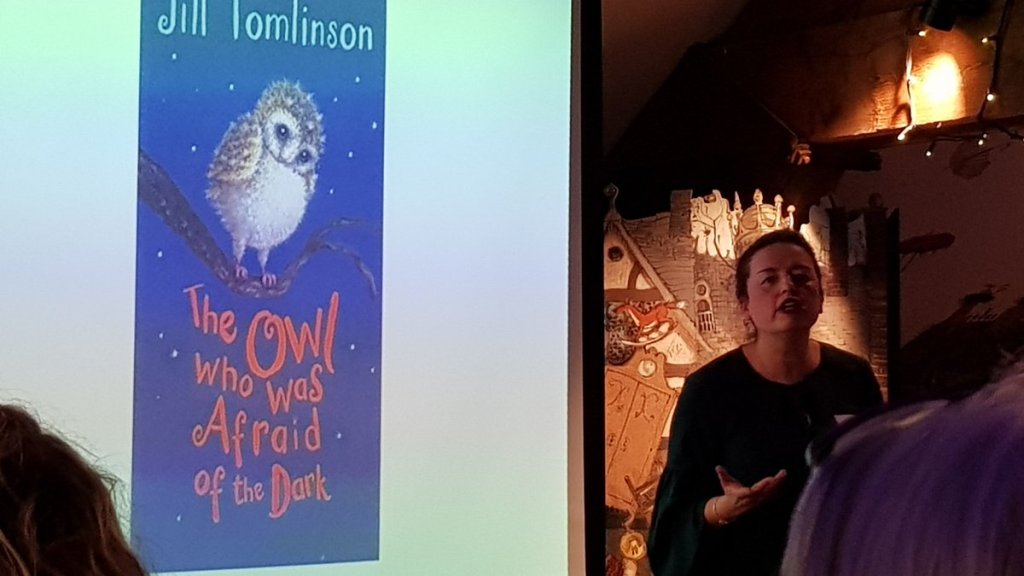
Ishbel Smith of Heart in Mouth talking about how our childhood stories can inspire us to better sharing of knowledge and experiences
Ishbel Smith, Heart in Mouth, talking about how our childhood stories can challenge and inspire us to think more deeply about how we encourage knowledge sharing.

What’s it all about? Who’ll be there?

The UK Knowledge Mobilisation Forum is an annual event for all those with a passion for ensuring that knowledge makes a positive difference to society. The Forum brings together practitioners, researchers, students, administrators and public representatives who are engaged in the art and science of sharing knowledge and ensuring that it can be used.

The Forum is designed as a space for learning and reflection, providing an opportunity for sharing knowledge, experiences and methods and access to some of the most up to date thinking and practice in the field. Expect conversations, creativity and collaborative learning…and if you’re wondering what we mean by ‘knowledge’ – we are as interested in practical know-how, skills and experience as in research findings or evaluation data.
Posted in collaboration, Events, KM | Tagged , , , | 1 Comment

The eye of the beholder

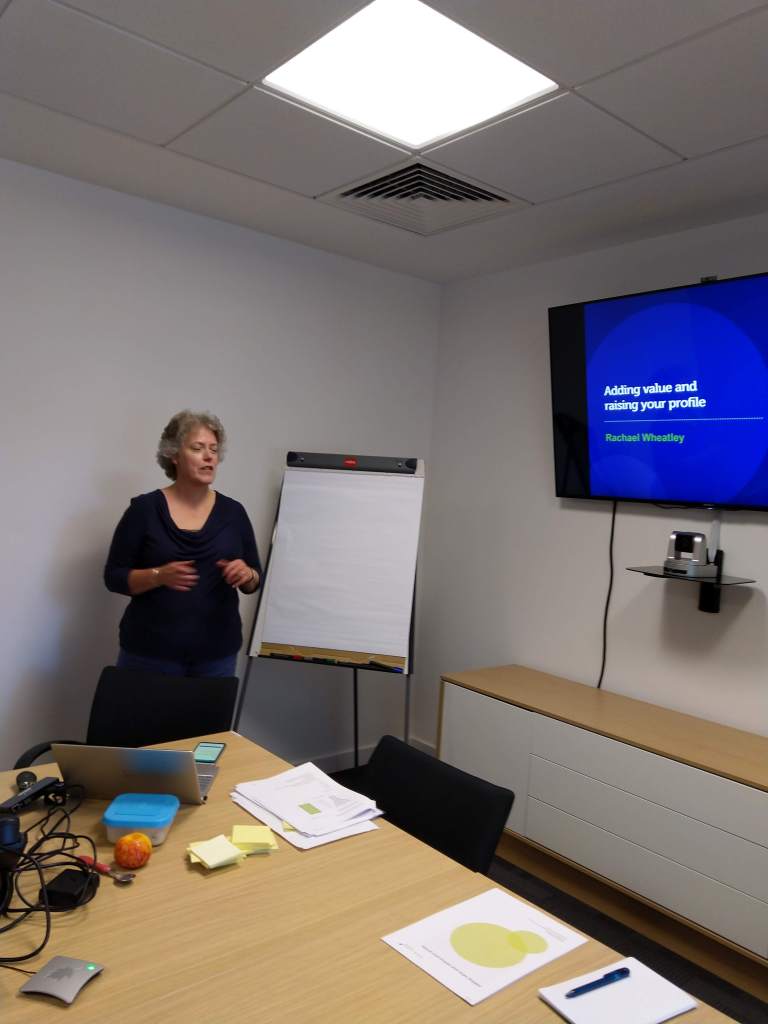
Rachael Wheatley explaining what "value" is, in marketing terms.
Rachael explaining “value”

Last week Bristol’s Knowledge Network group had a fascinating and challenging (in a good way) hands-on workshop all about “value” in Information, Knowledge and Learning in law firms.

We met Rachael Wheatley, specialist in professional services marketing from Bluegreen Learning, who talked about “value” from a marketing perspective and how Knowledge Lawyers, PSLs and KMers can analyse the value that they bring to their organisation in order to improve the service that they deliver and help others to understand that value to the business.

There was too much good stuff for me to repeat it all here, but if I had to pick one practical task to pass on to everyone, it’s this one.

“Value is in the eye of the beholder”, as Rachael says, and we must avoid making wrong assumptions about what aspects of our service our users/clients really value. If we fail to research *their* definition of value, this could lead us to prioritise the wrong aspects of our service.

But how can we start the process of researching “value”?

In order to understand what aspects of your service your internal clients really appreciate, you need to talk to them (obviously) but, if you can’t do that yet or you need to find a starting point for your conversation, a great first step is to consider the last piece of great feedback you received and analyse why that piece of work stood out for that client. What was different about it to all the other work that you do? Why did they love it? What clues are there in their feedback?

Why don’t you do this task right now?

Think back to the last piece of positive feedback you got and ask yourself :

  • “What was different about this piece of work?”
  • “What did they really value about what I did?” and
  • “How can I adapt my work to deliver results which are better aligned to what they value?”

And then go and talk more to your internal clients and see what they think about your suggestions for improvements.

Let me know in the comments section what you think and how you got on.

And if you enjoyed this post, please pass it on (social media buttons at the bottom).


If you are in UK and interested in training such as this for your Information, Knowledge and Learning teams, get in touch. KN-UK is a regional learning and knowledge sharing group and I am happy to expand to other cities where there is sufficient interest.

If you are outside the UK or can’t get along to a KN-UK, sign up for the blog (button in the top right) or the newsletter and keep up-to-date that way, or sign up anyway!


#Knowledge #Learning #Information #Value #Bristol #Workshop #LawFirm

Posted in Knowledge Network UK, Professional Support Lawyers | Tagged , , , , | 3 Comments

Adding value and raising your profile

Do you worry that your organisation doesn’t really understand the value that you offer? This is something that I often hear from PSLs and KMers in law firms, so to help with that, I’ve organised a workshop for my Bristol Knowledge Network UK group on adding value and raising your profile. More information and booking details are in the comments below.

If you are unsure whether this event is for you, or want to come but aren’t free, I’ve recorded this short interview with Rachael Wheatley of Bluegreen Learning, who will be presenting.

Posted in Knowledge Network UK, Professional Support Lawyers | Tagged , , , | 4 Comments

June’s First Friday News

I’ve just sent this month’s newsletter out and it’s all about love, engagement, interesting Japanese concepts and big sticks! And knowledge and learning of course.

If you think that sounds interesting, click here to have a look.

If you think you might want this sort of thing once a month (and a shorter round-up in between) you can join either the general newsletter or the one for textbook owners by following the links. I promise I won’t inundate your inbox. If anything it’s a bit hit n miss for once a fortnight!

Boy sitting on bench laughing at a book
What? What did I say that was funny? This is a serious newsletter about Knowledge and Learning!
Posted in Uncategorized | 2 Comments

KM Strategies – 5 top tips

*Update* My next KM Strategy event is on 30th April 2020.

I’ve a workshop on Strategies coming up next Thursday (8th May 2019), so it’s on my mind. (If you’d like to come there are still spaces.)

If you are DIY-ing, here are 5 handy tips/starting places:

  1. Be clear about what a strategy is and isn’t. You aren’t writing a to-do list, you are working out what the strategic direction of your Knowledge/Learning department is, in order to support your business in its objectives.
  2. Which leads me on to … Be very clear what your firm’s business objectives are. Sometimes this isn’t as straightforward as you might think. Spend time trying to really understand your business inside and out. You might need to remind senior people that you can only align your efforts to help them succeed if you know what their challenges are! Look at data. Benchmark.
  3. It’s great if your strategy is thorough, detailed and evidence-based, but sometimes this gets in the way of actually getting anything done. Achieving improvements in the business is better than endlessly waiting to perfect your strategy but doing nothing useful/practical. If you don’t have time for SWOTs and Scenario Analysis, do whatever you have time for and actually commit to starting to improve your business.
  4. Get a mentor/coach/buddy to keep you on track. Everyone is busy and can get derailed. I coach people after my strategy workshop to make sure their strategies get finished, but I also have a “business critical-friend/coach” of my own, who keeps my entrepreneurial feet on the ground to help me get stuff done.
  5. Keep it under review. It’s tempting once it is written to think “Phew!” and shelve it, but it needs to be a living document that responds to changing business pressures. Diarise to review it regularly and ask your buddy to keep you true to that commitment.

What do you think? Do you agree? What would you add/what would be your 5 top tips? I’d love to hear from you in the comments below.

Posted in Uncategorized | 1 Comment

Evidence-based practice

I recently attended the South West CILIP AGM, where David Stewart, current president, talked (amongst other things) about the importance of evidence-based practice amongst library and information professionals.

Couldn’t agree more – x2 for Knowledge professionals.

KM can be an expensive resource in law firms – bought-in subscription services, PSLs/KLs, IT systems, time away from fee earning for learning – none of these are cheap.

But when was the last time you were able to review the latest research on the best ways to encourage knowledge sharing in businesses? When were you last given the budget to attend training on the latest thinking on how adults learn in the work place?

What if you relied on following the crowd, but that meant … you were following them in an expensive and inefficient direction?

Your lawyers can’t just practice however they fancy without keeping up with the latest thinking in the law. Why should KMers be expected to?

Why is it like this? Is it snobbish-ness in some parts of the legal sector, not so much amongst KM professionals, but amongst the lawyer-managers? A sense that “Academics can’t know what it’s like in the real world” and “We don’t need buzzwords and management fads“? Or a sense that they must uncritically keep up with the Joneses and everyone has moved from “KM” to “Blockchain” to “AI” to “Innovation”?

How can knowledge-intensive businesses like law firms know what is the most efficient and effective approach to exploiting and selling the combined knowledge within their business? By knowing about the latest Knowledge Management research, analysing it critically and taking the relevant parts for an informed, effective practice. It surprises me that firms don’t seem to mind wasting money ignoring years of learning on the topic of “how to maximise profit from knowledge”.

I’m not necessarily talking about buying the latest technological gizmos: I’m talking about having the right practices in place to get knowledge shared around the business in what we have learned are the most efficient and effective ways.

I know that time is always a factor, but a lawyer would not be permitted to say “I was too busy to keep up with the changes in the law” in their defence of a professional negligence claim.

Agree? Disagree?

If you agree, what can you do to improve your evidence-based practice?

  • Read more books: Nonaka, Davenport & Prusak, O’Dell, Leonard (maybe even a Russell?)
  • Read a journal: the Journal of Knowledge Management isn’t a bad place to start.
  • Join a supportive learning group: in-person is best, but VC is not bad.
  • Attend some training: again, in-person is best, but on-line courses can be OK if they are well designed and you put effort in.
  • Look outside your sector: how are other sectors responding to their challenges? You might get some great ideas that no one else has tried in your sector yet – get ahead of the competition. And learn about and critically assess the value of other management tools: design thinking, UX, process and quality management.
  • Experiment and gather your own evidence: who knows your business better? Make sure you know when to drop an idea/pilot and move on. And make sure it’s always a learning experience.

Want to give these a try, but not sure where to start? You can DIY, or, if you like my stuff, I’ve a couple of things that can help, some paid-for, some free: book club, workshops, online courses, Knowledge Network UK, books, RCTs.

What do you think? Am I being unfair? I’d love to know what you think. And what other resources would you add to improve your own evidence-based practice?

Did you enjoy this post? If so you can follow the blog using the button at the top right of the page, or sign up for the 2-4 weekly summary.

Posted in KM, Personal Knowledge Management, Strategy | Tagged , , , | 1 Comment

Curiosity…?

It killed the cat. It went to Mars.

I’ve recently realised how important curiosity is to me. It encourages me to learn, helps me to have enjoyable conversations and makes life interesting. I don’t have a cat, so I should be fine.

I also recently read this article about how to talk about climate change using curiosity rather than lecturing.

It struck me that, as well as a great blueprint for a discussion on climate change, with a few tweaks, this is a great blueprint for most knowledge-related conversations. Perhaps a good toolkit for conversations with leavers to prevent knowledge loss?

7 step plan for a curious conversation

  1. Beforehand, consider the motivation for this conversation. What do you need to learn? Why are you doing this? Why might they engage with you?
  2. Make sure it’s the right time to talk for both of you.
  3. Lead with curiosity, make space for the discussion, don’t jump in, listen a lot. Asking “Why?” with curiosity releases knowledge. Asking “Why?” with judgment releases defensiveness.
  4. What do they know (what’s a concrete fact)? What do they think (what have they deduced)? How do they feel (listen with empathy and dig deeper to unearth more)? What stories do they have to illustrate these facts, deductions and feelings?
  5. What shall you both do now? What is the best way for the new knowledge you’ve unearthed together to be shared for the organisation’s benefit? Explore together the possibilities.
  6. Arrange to follow up and talk again. And do it.
  7. Build your conversational skills: use reflective learning to get better each time.

Interested? What can you do now?

Lastly …

Remember to be more like this guy!

#Knowledge #KM #LawFirm #KnowledgeManagement #Tacit #Curiosity #conversation

Posted in knowledge-sharing | Tagged , , , | Leave a comment

A sneak-peak

So I’ve released (at long last, I know, I know) my first online course.

I love in-person training and try to do as much of it as possible. There is nothing like a face-to-face conversation on a topic to ensure that your attendees have really understood what you are trying to help them with. You can adjust how much time you spend on what, and make sure you cover everyone’s particular challenges, so everyone goes away with a practical answer to a real difficulty at work.

But…

Quite simply …

Not everyone can come to London, Bristol or Birmingham or spare an afternoon or a day away from their desk.

I do the odd webinar, but they’re time limited and (I know from webinars I’ve attended) it’s hard, as an attendee, to maintain attention when other priorities are calling – too tempting to “have it on in the background” and miss the valuable stuff.

So I’ve created an online course to squeeze in between a webinar and an in-person workshop and satisfy the need for a more flexible, self-paced, available at your desk/home/spinning class type learning.

My first course is a beginner’s course, but I’ve plans for one on measurement and conversation (my favourite topics as you know by now).

What’s included?

  • A mix of videos, presentations, downloads, articles, quizzes and online discussions
  • I’ll be online each Monday to answer any questions or just have a chat
  • It’s my usual mix of “all the theory you need” mixed with “a dollop of real-world practicality”

If you’ve got any questions about it, drop me a line, otherwise I look forward to “meeting” some of you there!

Posted in KM, Professional Support Lawyers, The Knowledge Business, Training and learning | Tagged , , | Leave a comment

It’s go, go, go! The KN-UK programme is live!

Just finalised the programme for Knowledge Network UK in Bristol and Birmingham for 2019 and I’m *terribly* excited about it (maybe cause it’s Friday).

This year we’ll be covering:

  • the new BSI standard for KM
  • think like a marketing professional – using marketing tools and techniques to improve internal & external communication
  • behind the scenes look at how other sectors approach their KM challenges
  • design thinking for KM solutions – it’s not just techy solutions, design something that really works for your users
  • bring-a-problem workshop – learn from the wisdom of the crowd and thrash out some practical solutions with your peers

It’s £250 for one person (for 10 hours of learning?!) and £450 for a dual ticket for 2 people (from the same firm). If you would like to join, there is also an early bird discount for those who pay by 22nd March 2019.

If you would like more info or to join in the fun, email me at helenerussell@theknowledgebusiness.co.uk or comment below.

And if you live somewhere else in UK and want a KN-UK group in your city, let me know. Once I have 3-6 firms interested, I’m happy to get organising!

Individual tickets to single events will be available nearer the time via Eventbrite.


Posted in Events, Knowledge Network UK, Uncategorized | Tagged , , , | 2 Comments

Hercule Poirot: Subject Matter Expert and Knowledge Manager

If you are in the UK, you can’t have missed the excellent new adaptation of Agatha Christie’s ABC Murders over the Christmas holidays. See the source image

If you did miss it and enjoy a Golden Age murder, you can (at the time of writing at least) find it on catch-up here.

It didn’t seem terribly faithful to the book as I remembered it, so I decided to re-read the book alongside the series (and enjoy again a rattling good tale).

And while re-reading the original story, I was struck by how Poirot (well, Agatha Christie) has some excellent quotations about Knowledge and Learning and the power of conversation. I thought they might be useful,  so I’m sharing them with you.


On implicit and tacit knowledge and hunches…

Here Hercule is explaining why his “feeling” that there is something amiss about the murderer’s letters should be taken seriously.

“Not instinct, Hastings. Instinct is a bad word. It is my knowledge – my experience – that tells me that something about that letter is wrong.”

[…]

“But what is often called an intuition is really an impression based on logical deduction or experience. When an expert feels that there is something wrong about a picture or a piece of furniture or the signature on a cheque he is really basing that feeling on a host of small signs and details. He has no need to go into them minutely – his experience obviates that – the net result is the definite impression that something is wrong. But it is not a guess, it is an impression based on experience.”


On surfacing information (and knowledge) through conversation…

Here Hercule is trying to unearth from a group of witnesses and the victims’ families, any  facts or events, however small, that might link the seemingly random murders. So far the only similarity between the series of killings is that each victim’s name and home town links to a letter of the alphabet (the first victim was Alice Ascher of Andover).

“Telling everything you know always implies selection…. One cannot tell everything. Therefore one selects…. people select what they think is important. But quite frequently they think wrong!”

“And how is one to get at the right things? Simply, as I said just now, by conversation. By talking! By discussing a certain happening, or a certain person, or a certain day, over and over again, extra details are bound to arise.”


What do you think?

Was Hercule Poirot a Subject Matter Expert and Knowledge Manager at heart?

Have you come across any other fictional characters whose Knowledge and Learning quotes would be useful for training and discussions? I’d love to hear about them in the comments below.

And if you’ve enjoyed this post, follow the blog using the button at the top right or sign up for the roughly-monthly busy-person’s news, which gives a round-up of what I’ve been writing about and up-coming events each month or so.


Posted in KM, quotes, Training and learning | Tagged , , , , , | 2 Comments