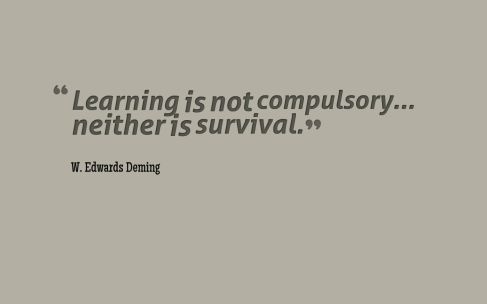
Learning is not compulsory …

learningisnotcompulsory

Posted in quotes, Training and learning | Tagged , | 1 Comment

3 common mistakes that waste your time

Most PSLs and KMers that I meet struggle with the demands of their teams and their role. This made me wonder – what are the 3 most common time-wasting mistakes that I made when a PSL?

mistake2


  • Failing to be strategic – PSLs tend to have very limited time for a potentially wide-ranging role. They need to understand the strategy of the department in order to support it in the best way. They also need to understand the *true* strategy of the department, which may be implicit and different to the actual written strategy. Find someone who will tell you the truth about what is important to senior management in the team and write a KM strategy which supports this.
  • Failing to learn enough about Knowledge Management theory and look outside the legal sector for inspiration – great strides have been made in relation to KM over the past 5-10 years and, although the data-info-knowledge pyramid has its place, it isn’t enough any more. Too many lawyers value only technical legal knowledge and discourage PSLs from pursuing their understanding of KM. There is a reason organisations like KPMG have massive KM support structures within their businesses – KM is complex but offers competitive advantage. Argue for your share of the training budget and spend it wisely (is another trip to KM Legal the right use of the money, what about a different conference or course).
  • Failing to value their networks and relationships – I used to think “networking” was for sales people and job seekers, and thought email was terribly efficient (probably a hang-up from those years spent chasing the chargeable hour!) Since I learned more about how information and knowledge is passed between people, I have begun to understand how important a trusting network is and, if you can manage it, face-to-face conversation. Make the most of your opportunities to network and meet people. This *is* a good use of your time.


Those are my lessons-learned from mistakes I’ve made. What would yours be? I’d love to hear in the comments below.

__

I don’t pretend to have all the answers, but I do what I can to help, so you learn lessons from my mistakes.

If you have resolved to learn more about KM theory and practice, I run a foundation course three times a year (January/May/September in London), an afternoon workshop on KM metrics in Feb/June/October and a workshop on KM Strategy in July (click here to see all my events on Eventbrite). I also run in-house and bespoke training sessions and can create your annual training day too.

I have also written 2 very practical textbooks for you.

If you want to join a network of like-minded law firm KMers, consider Knowledge Network UK, in Bristol, Birmingham and Manchester (so far).

And if you are interested in KM Strategy, I’ve written extensive about it in my KM Handbook textbook, but also here (for free, yay!) just search for “strategy” or start with this top tips post.

And for more freebies …


Save

Save

Posted in KM, Personal Knowledge Management, Professional Support Lawyers, Strategy | Tagged , , , , | Leave a comment

A good decision …

A good decision

Posted in quotes | Tagged , , , | 1 Comment

Getting savvier …

We had our media-savvy training yesterday at KN-UK Bristol – a very interesting 2 hours with Tony Coll, former BBC journalist and presenter.

Tony pic at Georgia PR school

Although I personally may not need to get my kind of business on the front page of the Daily Mail (or even The Guardian), I still learned a great deal about what makes a good story, what publishing groups and journalists are looking for, how to pre-empt the competition to get my quote used on a news story, and lots more.

I think Tony’s acronym “Chortle” will work well for me as a reminder of what makes an engaging read, which will be remembered later on, which is useful for all kinds of writing – blog posts, articles, even email subject lines.

(Don’t forget if you are looking to improve the clarity and readability of your writing as well as its engagement, you can look back at my series of articles from Sarah Fox, 500 Word Lawyer.)

I was also interested to learn some of Tony’s top tricks and phrases to make sure that, once I’m in touch with the journalist/media I’ve been stalking, I don’t then get backed into making quotes I didn’t want to make or saying more than I intended.

If you missed our session or you are looking for in-house training in this or other aspects of communication (presentations, pitches, crisis communications etc) you can reach Tony on 07813 480986 or via Tony Coll Media Training.

__


Our next KN-UK Bristol session is on Leadership and Influencing. You can book via Eventbrite or by emailing me for an invoice.

Our next KN-UK Birmingham session is on KM technology trends. Again, you can book via Eventbrite or by emailing me. If you have a Bristol KN-UK membership you can buy additional tickets to the Birmingham event at a 20% deduction, or swap for one of your Bristol events.

Save

Posted in Events, Knowledge Network UK, speaking, Training and learning | Tagged , , | Leave a comment

Heads of Knowledge Q&A (2) Lucy Dillon

It has been exciting to see so much interest (particularly on LinkedIn) in my previous post about Henrik Fagerholt, Head of Knowledge at international Oslo firm BA-HR. I’m so glad that everyone  is as interested as I am in the people behind the role.

This month we hear from Lucy Dillon, Chief Knowledge Officer at Reed Smith LLP.

__

Lucy Dillonlucy dillon

1. How did you end up as Head of Knowledge? Was there a key factor/turning point in your ending up in this role?

I spent several years as a PSL, later expanding my role and taking on some management responsibility. After my MBA, I moved to a director role.

The “key factor/turning point” was the MBA, which confirmed my desire to move into management and leadership.

2. What job did you envision having when you were young?

I always wanted to be a lawyer. I flirted with acting, but hated it!

3. If you could have any job in the world, with no limitations (salary, location, hours etc) what would you do?

Florist or theatrical designer.

4. Describe your firm in three words.

Quality, collaboration, global.

5. What is the hardest thing about your role?

Making an impact in an organisation of 1,700 lawyers in 26 offices.

6. What is the best thing about your role?

Same answer as 5!

7. What is the biggest change that you’ve witnessed during your career in Knowledge?

The role (good and bad) of technology.

8. What three things are you focusing on for the next three years?

1. Being new to the firm, same as 5 above,

2. Linking efficiency and LPM to KM, and

3. Exploiting KM in the client relationship.

9. What do you think is the most exciting new development coming in Knowledge work/KM?

The realisation (finally) that KM is vital in a knowledge business like law.

10. What advice do you have for aspiring Heads of Knowledge?

Focus on the business you are in and how KM can impact the bottom line.

___

Thanks Lucy.


If you have enjoyed this post, please share it with your network. The social share buttons are at the bottom.

If you would like to read the next Head of Knowledge Q&A, don’t forget to follow the blog (button at the top right) or sign up for the newsletter which gives a monthly round-up of posts and events (or you could do both of course).

And if you are a senior KMer in a law firm and would like to join in this Q&A series, email me or reply in the comments below. I’d love to hear your story.

Posted in Head of Knowledge Q&A, KM | Tagged , | 1 Comment

KM competencies

I came across this article on Monday about a model of KM competencies, which was developed as part of someone’s PhD.

It’s quite a nice summary of what corporate KMers can do (which can sometimes be hard to explain) and doesn’t focus too much on technology. It perhaps works best as a model of what a corporate KM team/department ought to be doing, rather than each individual KMer.

competencies word cloud

Although not all of these competencies apply to law firms and PSLs already have plenty of work to do as their team’s subject matter expert, I think this list gives a good outline of where KMers can add value to an organisation. In my view, PSLs who understand and work on these competencies as well as their own area of technical expertise, can help their firms in a strategically important way.

How many law firms (perhaps apart from the really large international ones) really understand the competencies of corporate KMers and how PSLs could be contributing to their organisations? How many PSLs in mid-sized firms have taken on a role from a previous PSL and have no theoretical KM knowledge and so no opportunity to contribute to their firm in this way? Are there plenty of law firms missing an opportunity?

What is your experience?

Posted in KM, Personal Knowledge Management, Professional Support Lawyers, Strategy, Uncategorized | Tagged | Leave a comment

Do you know your AI from your elbow?

There is *so* much going on in KM technology at the moment and so many articles about AI and other technologies that it can be difficult to find the time to analyse it all and decide what you should be focusing on for *your* firm. Wouldn’t it be nice to chat to some experts and get pointed in the right direction?

For this reason, I’ve arranged a talk on new KM technologies by 3Kites.

Tuesday 10th May 12.30-2.30 in Birmingham.

You can book via Eventbrite or email me for an invoice. See you there!

More info here.

If you can’t make it, perhaps you would kindly spread the word by sharing this page? Share buttons are at the bottom.


Posted in Events, KM, Knowledge Network UK, Strategy, Training and learning | Tagged , , | 1 Comment

Without knowledge …

knowledgewithoutaction

Posted in quotes | Tagged , , | Leave a comment

Raising your professional profile with journalists

Many PSLs are responsible for their department’s knowledge-based marketing, which often focuses on written articles about technical aspects of the law, but should you be improving your relationship with journalists? If so, how do you know what they want from you so that you can be the first lawyer they call?

With a fortnight to go before our Bristol KN-UK session on being a media-savvy lawyer, I asked Tony Coll, media expert, why lawyers should invest in improving their understanding of the media and how they can get over their nerves to become a go-to expert for journalists on their area of expertise.

___

Firstly, Tony, why are lawyers shy of engaging with journalists and why  should they change their ways?

What do you think of the media? Do you have a mental image of bright, shiny young people, asking inane questions on a sofa at some ridiculous hour of the morning? Fierce and tireless investigators with rapier minds? Or a sleazy old hack in a green eyeshade, unshaven and reeking of booze as he bashes out scandal on his old Remington..?Tony Coll interviews

These stereotypes live on, firstly because they contain a grain of truth, but just as importantly, because most people don’t meet all that many journalists, so old ideas from movies and TV tend to stick.

This means that most of us are understandably wary of talking to journalists. We think we’ll be tricked, or mocked, or have our private lives plastered all over News at Ten.

Lawyers are particularly mistrustful of the Fourth Estate. You know that you would suffer very serious consequences if your words caused a journalist to make a factual error, breach a confidence or report something that was sub judice. So you tend to be wary of speaking to journalists.

But try looking at it from their point of view.

When a reporter asks a lawyer for a comment, s/he will often get ‘no comment’ or an answer so hedged around with qualifications and circumlocutions that s/he grasps either the wrong end of the stick or no end at all. And the comment will often be delivered in such a dry and dispassionate way as to drain the story of all emotional content.

So no  lawyers do this particularly well? How can we improve?

That was the bad news.

The good news is that there is a HUGE demand for lawyers who communicate well in the media and there is a great opportunity to improve individual lawyers’ profiles and the profile of their law firm.

Journalists know that the law affects all of our lives, but tend not to understand it.

You, as a lawyer, know how your legal specialism touches lives, but probably don’t know how to explain it in a media-friendly way.

The solution is to take a media coaching or training session in which you learn to think like a journalist, learning the elements of news – what makes or doesn’t make a story. (Spoiler alert: the first letters of the elements of news spell the word ‘chortle’.)

Tony pic at Georgia PR school

You can then practise potentially difficult situations until you’re confident in your ability not only to avoid the pitfalls but to spot opportunities for positive media coverage.

Media training is a very effective way to teach you how to
• Talk generally in the media about your specialist field
• Speak effectively to the media on behalf of a client at the end of a trial
• Put the case for clients preparing for a class action
• Make effective, professional in-house videos on any of the above for your company website

What’s more, you’ll go into journalists’ contacts books (if you want to!) and get called upon whenever a comment or explanation is required from your branch of the law.

Becoming a media-savvy lawyer will heighten both your company’s profile, and your own profile within the company.

____

Thanks Tony.

If you are interested in improving your understanding of the needs of journalists, so that you can become the go-to expert in your field of expertise, come along to our Bristol training on 27th April. More info here.

Posted in Events, Knowledge Network UK, Professional Support Lawyers, speaking, Training and learning, writing | Tagged , , , , | 1 Comment

It takes considerable knowledge …

theextentofyourignorance

Posted in quotes | Tagged , | Leave a comment