
Heads of Knowledge Q&A (1) – Henrik Fagerholt

I’ve been interested in the people behind the Head of Knowledge role in law firms for a while now. It is often a role with a wide remit, encompassing difficult issues of organisational psychology with information technology.

What kind of person is attracted to this role and senior KM roles in law firms?

I thought a little research was in order and these are the results. I’ll post some of the answers I’ve received on the last Monday of the month. You can follow this blog using the button on the right.

If you are a Head of Knowledge or senior KMer in a law firm and haven’t taken part yet, drop me a line and join in!

Firstly we have the thoughts of Henrik Fagerholt, Knowledge Manager at International Oslo firm BA-HR.

___Henrik Fagerholt picture

Henrik Fagerholt

1. How did you end up as Head of Knowledge? Was there a key factor/turning point in your ending up in this role?

After working many years with software and product development I wanted a shift on to something a bit different. I had also recently finished a new master in strategic business development and innovation so a new job would certainly contain these elements.

After entering the market I had several interviews lined up, ranging from pure business development positions to working with disruptive teams. But in pursuing this, a fairly different position caught my eye. I think that the reason for this was that Knowledge management was an underlying topic that I had read with great interest in all the programs in my second masters. So even though it was not what I had envisioned originally, I decided to contact BA-HR when I read about the Knowledge Manager position. After talking to them I was very intrigued by their approach to both new technology and to Knowledge Management. During the process I got more and more persuaded that this was a job that I wanted and luckily I was offered the position.

It may seem a bit strange to work in a law firm and at the same time be very into innovation and technology utilization, but innovation in my mind is necessarily not only about hitting a homerun with the next disruptive technology. Innovation is more often about aiding businesses to utilize technology the best way and in ways that gives them a strategic advantage. This is becoming more and more important to BA-HR and the foundation of my work.

2. What job did you envisage having when you were young?

Sports, math and science were always my favourite topics at school and when ruling out a career in soccer, attending the “Norwegian University of Technology and Science” was the natural choice. I had masters in both “industrial economics and technology management” and “cybernetics” on the top of my list for a while, but just before the deadline I switched to “computer science”. The main reason for this was that I wanted to learn a craft from scratch and that a master degree in computer science would give me the flexibility to work in pretty much any area.

Even though I have abandoned a pure CS career now I really enjoyed the years I worked with software and product development. These years have given me lots of experiences and are a great foundation to any future career.

3. If you could have any job in the world, with no limitations (salary, location, hours, etc.) what would you do?

If I were to work with anything else, it would surely revolve around innovation, product and business development. My ambition now is to modernise the way our lawyers work and the way they share information and knowledge and I don’t plan to give up until I have made this happen.

4. Describe your firm in three words.

Dedication. Skill. Sharing.

5. What is the hardest thing about your role?

Being alone I think. I can discuss KM with pretty much everyone in the company, and our partners in particular are very aware of the importance of KM, but I often miss someone to discuss the in depth and complicated matters with.

Another thing that can be frustrating at times is to explain the underlying challenges and factors that need to be taken into account when working with technology. The good thing is that most lawyers are eager to understand, but on the flip side, most of them have an opinion even if they don’t. Luckily they all listen to reason, so it’s all about my being thorough and patient.

One thing that is not all that hard, but very different from what I am used to, is not being directly involved in the end product. For a decade I developed the product that the rest of the company relied on. What I do now is no longer core business, at least not in the short run. So even though considered very important, my work always comes second to work for our clients.

6. What is the best thing about your role?

The diversity and the possibility to really make a difference. I need to combine a large set of disciplines and have to talk to a lot of people to really understand the way the different lawyers work and interact. This, combined with a very dedicated and clever workforce that appreciates my efforts, makes every day exciting.

As mentioned before, being a bit alone can be hard, but at the same time this gives a lot of opportunities. If I make sure to anchor and quality assure decisions, I have the possibility to dictate the direction of my work to a great extent.

7. What is the biggest change that you’ve witnessed during your career in Knowledge?

I would say amount of information and the importance of search! The information you can find on the web just keeps growing and so does the information that everyone has to browse to find the relevant information for getting the job done. It’s no longer enough, or even possible, to be organised alone, you have to master the art of search. Most people have stopped looking for things, they search for it. At the same time it’s getting more important than ever to put information in the right place and label it with the proper metadata, otherwise it will be lost in the heap.

I would also like to mention a personal observation that has been an eye opener to me. When I really understood the importance of company culture and that technology alone is not the solution to everything, things started to make more sense. In Knowledge Management, and in any other domain for that sake, technology will not solve anything unless it is built around a natural way to do things and how people prefer to work and interact.

8. What three things are you focusing on for the next three years?

Internal communication. Project management. Document sharing.

9. What do you think is the most exciting new development coming in Knowledge work/KM?

When it comes to the law firms in particular, I am confident that cloud services in general will become more and more important in the future. Many sectors are already using this heavily and law firms should shift their focus on to cloud services sooner rather than later. There are still a lot of challenges to be solved, but it’s important to be ready and open and to make the shift at the right time. There is no doubt that this is what the vendors want and that this is their strategy, so in my opinion there is no other option in the long run.

In the debate about cloud services I think that there is too much focus on where the information is stored, this is secondary to me. In time this way of storing data will be both reliable and secure enough for anyone to do this without concern. What is often overlooked is that with these services there lie a lot of possibilities. This technology enables sharing and availability of information on a totally different level, both internally and externally. The ones that manage to embrace this will benefit greatly in my opinion.

As a final note, I think that it is wrong to focus on new developments in the KM area alone. New technology and changes in how we interact and organize ourselves never affect KM in isolation. I think that it is very important to understand how this affects the society as a whole and that different domains are affected differently and at a different pace. Hence, in my opinion, a holistic approach is crucial in trying to predict any future in KM.

10. What advice do you have for aspiring Heads of Knowledge?

No matter the background, I think that anyone can become an excellent Knowledge Manager. The important thing is to be curious and to understand that a broad spectrum of disciplines is needed to master this role, ranging from organisational psychology to business development and technology. In this role you also have to value human interaction and to be genuinely interested in understanding the needs and habits of others. If, on top of this, you listen to your counterparts and take important stakeholders into account when making decisions, you should have a solid foundation.


___

Thanks Henrik.

If you would like to read the next Head of Knowledge Q&A, don’t forget to follow the blog (button at the top right) or sign up for the newsletter which gives a monthly round-up of posts and events (or both of course).

And if you are a senior KMer in a law firm and would like to join in this Q&A series, email me or reply in the comments below.
Posted in Head of Knowledge Q&A, KM | Tagged , , , , , , | Leave a comment

Knowledge is like …

knowledgeislikepaint

Posted in quotes | Tagged , , | Leave a comment

Writing in plain English (Part 4 of 4)


Yesterday Sarah gave us a really useful acronym – write – to improve the process of our writing. Today, in our last discussion, I asked her to drill down some more on how to write clearly and what to write.

__

“Drafting a document in plain English takes a lot of skill. Communicating your points clearly so that the reader can accurately interpret your meaning is the most important task in writing. [Your] job is to communicate precise ideas, not produce a work of literature.”

Plain English Campaign

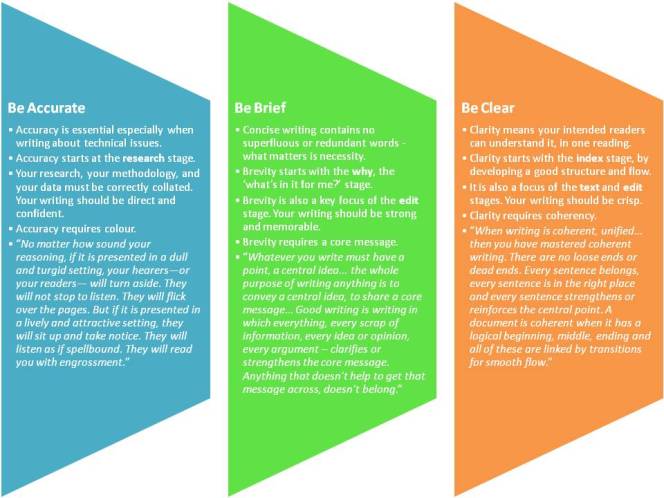
Your aim is writing which is:

accurate, brief and clear

Sarah Fox - be accurate brief and clear

__

If you have enjoyed this series of articles, come along to one of Sarah’s training lunches, either 22/03/16 in Manchester or  in Birmingham 14/06. Learn more here.


Posted in Events, Knowledge Network UK, skills, Training and learning, writing | Tagged , , , | 1 Comment

Writing in plain English (Part 3)

In this series of posts I’ve asked Sarah Fox, 500 word lawyer, all about her thoughts on how lawyers and others can write more clearly, whether that is for legal documents, emails to clients or marketing materials.

Previously I’ve asked Sarah about why we should all try to write more clearly. In this post I ask her how we can go about this in an organised way.

__

When writing any document you should take a structured approach. This applies not just to the task of putting pen to paper, but also to your preparation.

The process can be divided into 5 stages:


Sarah Fox on writing in plain english

Who? Why?

Tasks – Analysing (audience and purpose)

Focus – The reader: what’s in it for them? why are you writing? what action do you want?

Tools – Questions: who, what, why?

Research

Tasks – Thinking, collating, methodology

Focus – The data: what information does your reader need to answer the ‘why’ of the report?

Tools – Data collection. Primary/ secondary research tools. Tools for assembling, collating & culling raw material

Index

Tasks – Planning, ordering, structuring

Focus – The flow: how can you best present the data to answer the question?

Tools – Mindmaps, outlines; creative or linear structures.

Text

Tasks – Getting words onto paper

Focus – Quantity: everything you think you want to answer the question

Tools – Dictation systems, voice recorders, word and data processing software

Edit

Tasks – Reviewing, refining, analysing and clarifying

Focus – Quality: only what you need to say so your reader understands the answer first time

Tools – Readability statistics, grammar and spell checkers; proof-readers and editors.


The rough split of time for each stage is:

  • Pre-writing (planning) 25%
  • Text (writing) 25%
  • Editing & clarifying 50%

Most writers spend too much time on the text stage and not enough on either planning or editing (as opposed to proof-reading).

___

Thanks Sarah, I think that’s a really helpful summary. I know my personal weak spot is research and planning, in that I get too interested in what I’m learning/the bigger picture and don’t move into action soon enough (at least I’m sure that is what my editors would say!)

What is your weak spot and how will you fix it now? I’d love to know in the comments and I’m sure Sarah would pop over to answer a few questions too.


If you have found this post helpful, you can follow this blog using the button at the top right, sign up for the monthly(ish) newsletter with a round-up of posts and useful info, and come along to Sarah’s training event in Birmingham on 14th June.

Love-Learning-stamp-COLOURKNUK1

Posted in Events, Knowledge Network UK, skills, Training and learning, writing | Tagged , , , , , , , | 1 Comment

Writing in plain English (Part 2)

Yesterday I asked Sarah Fox, the 500 word lawyer and advocate for plain English in legal writing, about whether there truly was a problem with clarity in the legal profession.

Today I ask Sarah about the benefits of writing clearly.

___


The benefits of effective writing are clear.https://static.pexels.com/photos/8769/pen-writing-notes-studying.jpg

They are:

1. Action: when your reader understands the next steps you want her to take, she’s more likely to do so; the clearer your writing, the quicker your reader can understand and act upon what she’s read.

2. Boldness: good communication builds trust, and helps your reader believe in you and your conclusions; a bold message is easily grasped.

3. Credibility: it inspires confidence in both the reader and the writer – clear writing is evidence of clear thinking.

4. Efficient: effective writing is succinct. Shorter documents are more likely to be read, create fewer misunderstandings and less frustration for your readers. Badly-written communications lead to increased administration, as well as loss of clients, projects or more disputes.

(Read more here from James Hurford)

Effective writing is simple. It involves two distinct aspects of knowledge and skills – learning what to write and how to write.

__

Tomorrow I will be asking Sarah about “how” – how we can all write better.

If you would like to follow this blog there is a button at the top right, or you can sign up for my newsletter which gives a monthly round-up of posts and other useful information.

And if you would like to learn more from Sarah herself, come along to our KN-UK session on 14th June in Birmingham. Book via Eventbrite or email me for an invoice.

Posted in Client-facing KM, Events, Knowledge Network UK, Training and learning | Tagged , , , , | Leave a comment

International Projects and Management

Sometimes we get the opportunity in Knowledge Network UK to hear from a speaker who is from a different background to our professional services and knowledge management background, and it is always interesting and thought-provoking.

Today we heard from Dr Gaggiotti, course director of the MBA at UWE, who talked about his specialist area of expertise – international management.

Dr Gaggiotti has a fascinating background, having a PhD in Anthropology as well as an MRes in Management, which involved six years ethnographic fieldwork working with global managers in the oil and gas industry.

Personally, I knew very little about international projects and management. My area of practice when I practised law was UK clinical negligence, so I rarely even considered non-UK laws, let alone had the opportunity to work abroad. Now I’m networked into many different countries and meet a variety of KMers on my foundations in KM course, although I still don’t work abroad.

Despite this, I found the session really interesting. I studied international cultures as part of my MBA, but it was interesting to hear the more up to date research into the field and new understanding of its complexity.

In particular, it was interesting to learn that it is more important to clients these days to have a multiplicity of nationalities on a foreign project, than it is to have a particular person on the team who matches the client’s culture/language. And it was interesting to learn about the particular sensitivities needed when  sending managers against the traditional/historical flow, i.e. from Finland to Sweden, or from India to UK.

As always at KN-UK, it was interesting to have my assumptions questioned and to learn something new and widen my perspective a little.

___

If you are interested in the topic of international management and would like to chat to Dr Gaggiotti, his contact details are here.

If you are interested in widening your perspective and would like to come to KN-UK, there is more info here, or you can get in touch with me.

Love-Learning-stamp-COLOURKNUK1

Posted in Events, Knowledge Network UK, Training and learning | Tagged , , | Leave a comment

Writing in plain English – a question a day

I am really excited to have Sarah Fox, the 500 word lawyer, speaking at my first Manchester KN-UK event next Tuesday (22nd March) and again in Birmingham on Tuesday 14th June.

Knowing Sarah, it’s going to be a very interesting, practical and useful session.

However, as I know this is a topic which everyone is interested in *right now* I asked her a couple of questions over the weekend and I’ll post her answers here this week.

Firstly I asked her if there truly was a problem with poor communication in legal documents and why we should bother to write more clearly, because it often takes more time than wheeling out the usual stuff.

___

“The single biggest problem in communication is the illusion that it has taken place”

George Bernard Shaw

The legal profession tends to believe that it is better than average at communicating with its readers – clients, staff, prospects, judges and social media users. Regrettably, in many cases that confidence is misplaced. In fact Bryan Garner, a leading US advocate of plain language for lawyers, says that the legal profession suffers significant barriers to communicating including:

We persist in making our profession exclusive, all the while rationalizing our inability to write well by invoking age-old legal standards

We have a history of wretched writing … [these] poor models that continually fortify the lawyer’s bad habits (1)

External factors can encourage you to write more effectively.

Over the last 40 years, across a wide range of industries and services, there has been a push towards the adoption of plain language with ‘consumers’ (in the UK this has been led in part by the Plain English campaign). The U.S. and South Africa have introduced laws requiring authorities to use plain language in public documents (2). The UK government recognises it has a role to play and commissioned a report on ‘When Laws Become Too Complex’ in 2013 although without any real proposals for change!

Although many plain language campaigns are often restricted to public sector bodies or consumer laws, plain language is good practice in all business documents. Plain language is ‘communication your audience can understand the first time they read or hear it.’

“Don’t write merely to be understood.
Write so that you cannot possibly be misunderstood.”

Marcus Fabius Quintilianus (3)

There may also be internal pressures, from your firm or bosses. Many law firms include straightforward, clear, or plain-talking as one of their values. Although – initially – staff will spend more time preparing simple, clear documents, your readers will spend less time reading and interpreting them. This saves your firm time and money, as well as reducing the risk of misunderstandings, calls to clarify and ask further questions, and breaking trust with your readers.

As you become more skilled, effective writing will become second nature to you.

(1) Garner (2002), The Elements of Legal Style, chapter 1

(2) For more information on government initiatives on plain language, see the PLAIN website.

(3) More exactly in Book VIII of his De Institutione Oratoria “We should not write so that it is possible for [the reader] to understand us, but so that it is impossible for him to misunderstand us.” (95 AD)

___

Sarah will be answering another question tomorrow, so follow the blog (button at the top right) to get notified when it is posted, or sign up to my newsletter for a monthly round-up of blog posts and other interesting stuff.

And if you are near Birmingham on Tuesday 14th June, come along to Sarah’s training session and learn how to make skilled, effective writing second nature to you.

Posted in Events, Knowledge Network UK, Training and learning | Tagged , , , | 2 Comments

Is your knowledge deep enough?


“If you can’t explain it simply,

you don’t know it well enough.”

Einstein.


Often I think I understand something something new, but when I try to explain what I’ve just learned, it slips from my grasp.

I find teaching others is a great way to embed new learning.

As one is forced to explain new knowledge in a different way to someone with a different world view, one is forced to analyse and process it.

Five simple ways we can all learn through teaching:

  1. supervise a trainee or junior member of staff
  2. run a training session
  3. write an article on the topic (could be for an internal newsletter, peers or for clients)
  4. write a blog post
  5. write an entry in a reflective learning diary

How else do you learn something deeply enough to be able to explain it simply? I’d love to know in the comments.

If you are looking for training in KM, have a look at KN-UK’s programme of events in Bristol, Birmingham and Manchester.

Love-Learning-stamp-COLOUR

Posted in Training and learning | Tagged , , , | 2 Comments

1 week to go – Dr Gaggiotti’s talk on International Management

I’m getting quite excited about our first Bristol KN-UK session next Monday (14th March).

Dr Hugo Gaggiotti from UWE is coming to talk about his specialist field of research – international management – and to give us some top tips about how to manage international projects more effectively.

Even with relatively simple business matters, it can be difficult to manage different styles, customs and cultures (an amusing example for you!).

I’ve never done much international work myself. I spent my “practising life” doing UK clinical negligence work and my “KM life” so far working in and with UK-based law firms, but with my new online KM-Uni which I’m currently developing, I’m going to have to get to grips with different cultures and styles, so I’ll be quizzing Dr Gaggiotti for some top tips for myself as well as for KN-UK members!

If you are interested in coming along, more details here.

Or book via Eventbrite.

 
£250 for 8+ hours of quality CPD delivered as workshops/masterclasses, over a lunchtime, local to you? Why not?

Posted in Events, Knowledge Network UK, Training and learning | Tagged , , | Leave a comment

It’s world book day!

It was World Book Day yesterday and book week at my kids’ school. Today is their dressing-up day so I’ve sent them to school, one dressed as Geraint Thomas (autobiographies count I’m sure) and the other in pyjamas as a Topsy Turvey (don’t know it? Great book!).

Book Week/World Book Day is a great reminder to reflect on all those books which have made a difference in our lives and be thankful that people make the effort to write and publish them for us.

I’ve written before about recommended reading for new PSLs/KMers in the legal sector, so I thought this time I’ll choose my favourite book.

Then I realised how impossible that was, so I chose a top three.

I’ve read a lot of great books, and I wish I could include them all, but these are the most dog-eared, well-thumbed ones, which I return to again and again.

  1. “Idiots Guide to KM” Rumizen – written a while ago now, so the tech opportunities in KM are different, but a great go-to book when you want to sort out the basics in your head before you delve deeper.
  2. “Working Knowledge” Davenport & Prusak – another older one, but standing the test of time well. Lots of great theory and practical examples,  and, like me, a great proponent of conversation in the workplace!
  3. “Critical Knowledge Transfer” Leonard, Swap and Barton – a much newer one (2015), but great for getting your head around learning and knowledge transfer.

So if you had to choose only three KM/learning books, which would they be and why? I’d love to know below in the comments.

Bristol Learning City


Posted in KM, Personal Knowledge Management, Training and learning, Uncategorized | Tagged , , , , , , | 1 Comment